
April Business Insight
April Business Insight from The Zinc Group
Debt Collection and Decision Science
This month’s business insight from the Zinc Group is delivered by our Head of Decision Science, Kjartan Hearn, who has been a member of the Zinc senior management team for over 3 years, having previously worked within the digital banking sector and currently works part time as a Lecturer at Warwick University.
One of the major components of Decision Science is the application of ‘automation’, where and when it should be deployed, and critically how it is monitored for success and positive customer outcomes. Something often overlooked however is how this may impact staff and team members. This month’s business insight aims to shed some light on this important aspect.
Debt Collection and Digital Transformation
Automation in debt collection, like other industries, has experienced exponential growth in recent years. This can take various forms, such as implementing a new dialler solution that reduces call time, using robotic process automation (RPA) to automate repetitive tasks, or introducing digital solutions that enable customers to self-serve. These technical advancements have the potential to create a leaner, more efficient, and effective workforce.
However, with these changes come new challenges. For example, when 40% of a worker’s daily tasks have been automated by RPA, what becomes off their role? Without proper understanding of how these technologies can help employees and businesses, workers may start to feel threatened.
Introducing RPA is considered a digitisation, which is the first step in the journey towards digital transformation. This process involves optimizing existing processes and projects within a business.
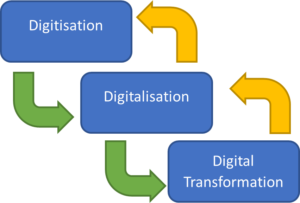
- Digitisation involves digital projects within a business.
- Digitalisation is the integration of digital projects across a function, helping to break down informational silos.
- Digital transformation involves a complete revaluation of a business, with a focus on embracing technology to drive competitive advantage.
The road to digital transformation presents many opportunities for businesses. By involving teams in this journey, companies can create a more inclusive, transparent, and empowered workforce. This, in turn, can drive efficiency, effectiveness, and positive cultural change within the company.
Here are six ways you can empower your teams and encourage their involvement with Digital Transformation:
- Provide adequate training and support: Offer training programmes to help staff members gain the skills and knowledge required to work with new technologies. Ensure they have access to support resources to help them through the transition.
- Involve them in decision-making: Ask for input from staff members when selecting new technology and digital solutions. Encourage them to share their ideas and concerns and take their feedback into account when making decisions.
- Communicate regularly: Keep staff members informed about the progress of digital transformation initiatives and explain how these changes will impact their roles and the organisation. Provide regular updates and be transparent about the changes being made.
- Foster a culture of experimentation: Encourage staff members to experiment with new technology and digital solutions. Provide them with the space and resources to try new things and take risks and celebrate their successes.
- Recognise and reward progress: Acknowledge the efforts of staff members who have successfully adapted to new technologies and digital solutions. Offer incentives or rewards for those who have contributed to the success of digital transformation initiatives.
- Create a sense of inclusion: Encourage staff members to take active part in digital transformation initiatives and to see themselves as integral to the success of these projects. Provide them with opportunities to lead and contribute to the development of new processes and technologies.
Kjartan Hearn – Head of Decision Science the Zinc Group Ltd